Contact Us

14-16 Walsingham RoadHove, BN3 4FF

Telephone01273 735221

Rebuilding out of COVID-19

By 5th May, 2021 Care Home, covid-19 Comments Off

As lockdown begins to ease, this might be the first time you are able to see your relative with dementia this year. With such a long time apart changes in their condition may be more apparent and trying to ensure COVID-19 guidance is followed may be particularly hard when your focus will be making sure the person with dementia is as safe and comfortable as possible. However it is important that we continue to stick to the rules to try and ensure we don’t have to deviate from the current roadmap.

The biggest news must be the ability to now visit loved ones in their care homes. This can be two visitors (one at a time) on a regular basis (ie the same two people must visit each time). This brings with it another set of challenges… what if your mum is in a care home and you are one of three siblings, how do you choose? How do you explain to your mum, when communication is more difficult, that one of her children isn’t allowed to visit. Although not perfect, it is progress and we will continue to arrange video calling for all those who are unable to visit for whatever reason.

With the widespread launch of free lateral flow testing, we hope that COVID-19 is coming under control and we will continue to test our staff regularly. We will also ask anyone entering the home to test and await their result before they are allowed to enter. Please bear this in mind if you are coming to visit, that you will need to arrive 30minutes prior to your slot to allow time to take the test and await the results.

For the foreseeable future we will continue to live with restrictions to protect the NHS and continue to save lives, so how can you start to introduce the “new normal” and begin to socialise once again with your loved one with dementia?

  • Embrace the time you do get to spend together, bring photo albums and reminisce about happy memories. Photo albums can be a great source of stimulation and will help not only reminisce but keep your loved one in touch with what has been going on in the family during the various lockdowns.
  • Use music to help stimulate conversation – play a favourite song or a song that takes you both back to a special event or place. Whenever I hear the lambada it always brings back a memory of my nana and grandad dancing on a warm sunny evening. It’s amazing how a song can take you right back to a moment in time.
  • Get outside together, whether this is a walk along the beach, in a park, or perhaps there is an activity you enjoy together like painting in the garden, or a spot of tennis. Activities give your loved one a sense of purpose and belonging.
  • Lockdowns have given even greater focus to technology and not everyone finds technology easy to use. It might be better to have a telephone call, rather than increase stress with new technology if your loved one hasn’t got the help they need. It is a good idea to call at regular times of the day to build a routine.
  • You could also send things through the post to help with the continued feelings of isolation – the world is opening up, but it is slow and the feelings of loneliness continue. This could be a letter or a card, or perhaps you could put together a photo book with descriptions and messages from other family members.

With all the new rules and regulations and COVID-19 guidance, remember this may be confusing and worrying for someone living with dementia. Continue to be understanding and patient and help them through the transition period to when we can hopefully all be together again.

COVID-19 and Dementia

By 29th March, 2021 Care Home, covid-19 Comments Off

There has been lots of talk in the press about the “forgotten victims of Covid” referring to school children and their education. Without doubt, they need more support and the make-shift homeschooling was no replacement for in school learning.


Working in the care industry we feel those suffering with dementia have truly suffered during the pandemic. If you read the research on dementia and reducing the affects, you will see the majority of advice and research shows the benefits of a routine and socialisation, both of which have been taken away to protect the vulnerable from catching COVID.


It’s a double-edged sword – on the one hand we need to protect people from catching COVID and potentially dying, however for those with dementia the loss of routine and socialisation may increase their dementia symptoms. In fact, the findings of a survey conducted by the Alzheimer’s Society of people with dementia and their carers, stated 82% of people reported an increase in symptoms among people with dementia after the March 2020 lockdown.


This was attributed mainly to a lack of cognitive stimulation and loss of routine. In the lockdown environment, we are no longer able to take part in stimulating or meaningful activities such as attending support groups or walking groups and are therefore limited to more mundane tasks. This has negatively affected people with dementia in terms of their illness and their self-worth.


For us with the care home, we are lucky we can continue to socialise amongst the residents and we have a full entertainment programme to encourage interaction and general merriment. We can maintain the residents’ routine as much as possible, obviously anything that was part of their routine outside of the home has been reduced or stopped however we are currently still getting out in the fresh air.


For those at home with dementia, the past 12 months must have been so difficult, unable to see friends and family. Not able to go out and do normal activities like shopping, meeting a friend for coffee and cake, or sports. It really has taken its toll, Over a quarter (27.5%) of people who died with COVID-19 from March to June had dementia.

But now we look to the future and how we will transition out of a lockdown situation. For the majority of us, we are excited to return to some sort of normality, but for those with dementia the outside world may not be the familiar surroundings they remember. For example, different shop layouts and processes may be disorientating. Signs and floor markings could be confusing and people in masks might be unsettling and/or difficult to understand. With numerous new rules to follow to keep everyone safe, this is something else to worry about, and also how others might react if they were to get it wrong.


In order to have an easier transition out of our current lockdown status, it is essential that those with dementia are supported by carers, services and the wider society. It has been reported that after the last lockdown those with dementia felt forgotten and abandoned and generally felt there was a lack of support when exiting the first lockdown.


So when we are out and about and continuing to follow the social distancing guidelines, remember that there are people in our community who might not be able to wear a mask or understand why they need to wear one. In a shop, there might be people who find it hard to follow the signage or understand they need to keep their distance. We need to remember to treat these people with patience, kindness and compassion.


We hope that all the dementia friendly practices that had been adopted by many shops before the pandemic such as clear signage, and staff who are trained to support customers with dementia can continue. We need to include and consult with people with dementia to develop communication and processes that promote their wellbeing and social inclusion and help them to live in world that might not be as familiar to them as it was before.

COVID-19 – Our Journey so far

By 1st December, 2020 Care Home, covid-19 Comments Off

As COVID-19 becomes a part of our everyday lives we have had to adapt to try and keep ourselves and our residents as safe as possible. Although there is talk of a vaccine we don’t know when it might be readily available, and if we have learnt anything over the last few months, it is that supplies to counter COVID cannot come quick enough. It really has been an extremely difficult time for us as a care home, trying to find the best possible way to tackle the pandemic. Obviously we followed all the guidelines set out by the various different bodies, but we felt this wasn’t enough for us, our residents are part of our family and we care deeply for each of them, so we researched and implemented numerous procedures and policies to protect our residents and our staff as far as we could.


  1. Reduce Risk

Firstly, we wanted to ensure that there was little chance of the virus reaching our homes. We shut our doors 3 weeks before the original lockdown and all non-essential visitors were cancelled. This was a difficult step for us to take as we have always had an open-door policy and love having visitors into our homes. Then we put in place as much varied entertainment as we could for the residents to try and compensate for the fact we would no longer be getting out and about and some of our regular visitors like Pet Pals would no longer be coming to see us. Our care team have been amazing, they have turned their hand to so many different roles – beauticians, hairdressers, spa therapists, dancers, singers, bakers, the list is endless, and it really shows just how caring our team is.


They sacrificed seeing their own family to ensure our residents were protected. We wanted as little contact between our team and the outside world as possible, we provided their essential shopping, so they didn’t need to visit the shops. We also provided lodgings so they could isolate and only be in contact with other staff members and the residents.


  1. Contingency Planning

We already had a number of contingency plans in place to include things like we would react to a flood, disasters, lack of services and (luckily) flu pandemics. We had also been working on a reinforced contingency plan in the months prior to the pandemic and this is why we were so able to fly into action the way that we did. We modified our flu pandemic contingency plan to a covid-19 pandemic plan and stuck to this until more information became available.


We then considered what would happen if COVID did get into our home. We created an isolation area for anyone displaying symptoms away from the other residents where they would be kept company by one member of the team. There was a programme in place for staff to provide 1:1 activities to prevent social isolation.


We also researched the best care we could give anyone who was suffering with COVID-19 and it seemed hydration was key so we briefed all staff on this and stocked up on jelly drops so we were ready should the worst happen.


  1. Maintaining Contact

The pressure on the team was immense, with longer hours and more procedures and cleaning than usual, plus the added stress of not being able to see their own families during their time off. However, we knew it was important to try and allow our residents to see their friends and family, so we invested in more ipads and we arranged as much video calling as we possibly could. We accepted gifts on the doorstep on special days, leaving them for 72 hours to decontaminate and we got the residents writing postcards to their loved ones. We also increased our postings on our private social media group so our residents’ loved ones could see we were making the best of it and still having lots of fun in the home. We know it wasn’t the same as seeing someone face to face, but it was the best we could do in the circumstances and our number one priority has and always will be the safety and health of our residents.


  1. Wellbeing

We followed the initial advice that we could find, this included vitamin D so we spent lots of time in the garden and the sun room, ate lots of leafy greens and ensured everyone had plenty to drink to keep hydrated. We also have a supply of jelly drops which the residents love. Lots of homemade cooking and activities were doubled, if you were in one of our care homes you probably wouldn’t even know a pandemic was going on (apart from the PPE) as everything was very ‘normal’ in the homes and everyone had a lovely summer.


When lockdown was lifted we  joined up with peddle people again and they worked hard to put procedures into place that meant that they could take our residents out for rides into the community. This allowed families and friends to (socially distanced) join their families out in the community and experience normal activities. We were able to increase the amount of contact that families were able to have with their loved ones.


We also had family garden visits and installed a screen in the tea room for extra protection. We followed social distancing and all infection prevention measures to ensure the safety of the residents.


We invested in the Gateway. This was a machine we could put at the entrance to the home which would take a temperature before asking the visitor to proceed through. In the gateway the visitor is sprayed with an antiviral dry-mist providing full-body coverage to minimise the risk of a person carrying virus particles on their clothes.


The harmless dry-mist is used in healthcare, food safety, water treatment and general sanitation. It is made from hypochlorous, which is created naturally in the white blood cells of all humans and animals for healing, protection and to fight infections. It disables virus particles present on clothes or exposed skin on contact. We felt this would be an additional barrier and safety measure for our home that would make us feel more comfortable about inviting families to see their loved ones.

To help our staff manage and to ensure only one family were visiting at a time we developed an online booking system where families could book either video calling or a visit to the home, and just as we got it all up and running, we were put into lockdown again. This time we are more ready and prepared, we are just sad that the families won’t be visiting, however we now have the system ready for when the lockdown is lifted and families can continue to book video calling.

Keeping normality when the world isn’t normal

By 16th October, 2020 Care, covid-19, Dementia, Family Related Matters Comments Off

This year has been one of the strangest on record and it’s not over yet. It seems Coronavirus is probably here to stay and has had the biggest impact on the care industry, this coupled with the added challenge of being a dementia specialist care home has meant trying to implement enormous change whilst trying to minimise the impact on our residents.


All the research you read about dementia always states as advice “maintain a routine” this is all well and good, but when the routine is no longer practical with lockdown restrictions and protecting the most vulnerable, what do you do? Here are some of our thoughts:


  1. Think outside the box

For those who regularly enjoy something outside of the home, which might not be available now, this could be a major disruption and may set them back in terms of their dementia and wellbeing. Could you think of recreating this activity inside the home somehow? For example, if your loved one liked to go to the local tea shop for tea and cake every Tuesday and you would rather they stayed at home, why not set a table and chairs up in their home like the tea room and bring the tea and cake to them.


If your loved one enjoyed a pamper session, bring it to them. In our home, our carers have been doubling up as beauty therapists offering a wash and blow dry, nail painting and even hosting a mini spa day in our Sweet Shop. If you can’t turn your hand to this, perhaps someone else in your family can. There are also mobile beauticians however this may feel too much of a risk.


  1. Stay Calm

It can be really worrying when there is a threat to a loved one, you just want to protect them, shut them away and hide from the outside world. If your loved one doesn’t understand the pandemic, or the seriousness of the situation, they may feel like they are being held prisoner. You need to be able to talk to your loved one in a clear and calm manner focussing on the facts to explain why your loved one needs to self-isolate. If they are adamant they want to go out, try and encourage the safest activities – a walk in the countryside perhaps?


  1. Exercise

Try and stay active, if you are lucky enough to have a large garden walk around the garden, maybe do a spot of gardening. Take a walk in a spacious country area, or if you want to stay indoors try an online gentle stretching class or how about laughter yoga online? This will benefit you and your loved ones releasing any stress and relaxing the mind.


  1. Keep routine

I know not everything in the routine can stay the same, but try and maintain those things you can – waking time, mealtimes, bedtime. Routine is so important to dementia sufferers, the more routine you can keep to, the better. If things need to change, try and introduce the changes gradually where possible.


  1. Get Creative

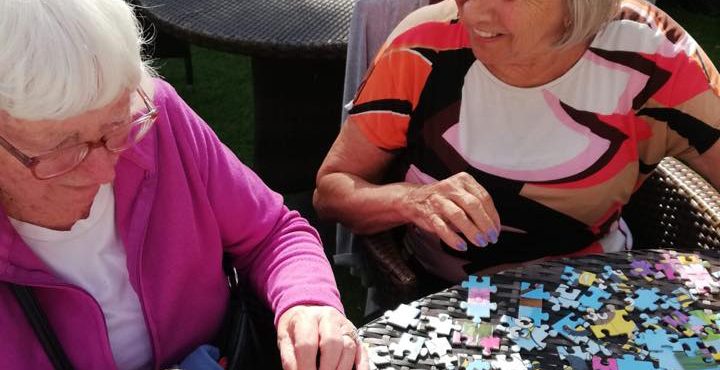
Perhaps now might be a good time to try something creative, painting or writing. Try to keep the mind active – puzzles and crosswords are good, as well as reading or listening to music. All of these things are known to improve wellbeing, not just for your loved one, but for you as well. Give it a try and you may end up dancing around the house!


  1. Keep talking

If your relative is in a care home and you are not allowed to visit, find other ways to communicate. Perhaps, like us, the care home could organise video calling so you can see each other (albeit on a screen). You could write a card or letter, record a video message or speak over the phone. It is important to maintain contact and we have been more than happy to arrange this at XX.


It is a challenging and uncertain time for us all as we try to adapt and look after those most vulnerable to the virus. Don’t forget your own wellbeing and to take care of yourself too.